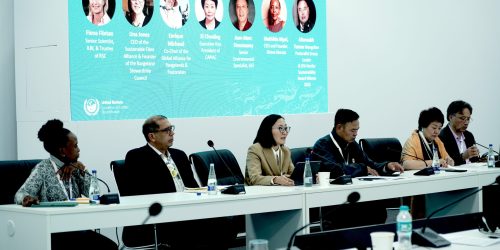

As UNCCD COP17 gets underway in Ulaanbaatar, Mongolia, the focus for the Rangeland Stewardship Council is clear: how do we turn growing recognition of the importance of rangelands into practical action?
Rangelands are increasingly being recognised for their importance to climate resilience, biodiversity, food systems, rural livelihoods and sustainable production. The International Year of Rangelands and Pastoralists 2026 has provided an important opportunity to strengthen that global attention and ensure that pastoralists and rangeland communities remain central to the conversation.
For the RSC, the challenge now is to connect recognition with the practical systems needed to support responsible rangeland stewardship at scale: strong partnerships, credible frameworks, evidence, investment and market recognition.
That momentum has been building throughout the year.
Earlier in 2026, a Parliamentary Reception in London brought together parliamentarians, diplomats, multilateral organisations, researchers and rangeland stakeholders, helping to raise the profile of rangelands and build political engagement ahead of COP17.
In June, during London Climate Action Week, the Rangeland Finance Forum was convened at the Embassy of Mongolia to bring greater attention to another critical issue: the need to mobilise significantly more finance for the sustainable management and restoration of rangelands, and to strengthen the connections between investment, responsible stewardship and benefits for pastoralist communities.
Now, in Ulaanbaatar, COP17 provides an opportunity to bring these different strands together and move firmly towards implementation.
At the centre of the RSC’s COP17 programme will be the High-Level Launch of the Global Rangelands Standard on 26 August— an important milestone for the RSC and for the wider effort to advance responsible rangeland stewardship globally.
The Standard is being developed as a globally relevant foundation for responsible rangeland stewardship, while recognising the enormous diversity of rangeland landscapes, pastoral systems, governance arrangements and production contexts.
It is not intended to prescribe a single model of management. Rather, it aims to provide a common foundation that can support governments, pastoralist communities, producers, businesses, investors and technical partners, while allowing implementation to remain locally appropriate.
Importantly, the launch is not the end of the process.
It is a defining step forward, marking the beginning of the next phase: continued engagement, practical application, learning and the development of implementation pathways across different rangeland contexts.
The launch sits within a wider RSC programme at COP17.
On 24 August, Financing Land Restoration at Scale: Investment Pathways for Rangelands will take forward the finance agenda, exploring how public, multilateral and private finance can work together more effectively to support rangeland restoration and responsible management.
The discussion will consider what is needed to create the conditions for investment at scale, while ensuring that finance delivers lasting environmental and social benefits and reaches the pastoralists, producers and communities responsible for managing these landscapes.
On 27 August, Value Addition for Sustainable Commodities: Linking Soil Health, Rangelands and Global Markets will focus on another essential part of the equation: how responsible stewardship and credible environmental outcomes can be better recognised within markets.
The session will explore how science, monitoring, traceability and voluntary sustainability systems can help strengthen buyer confidence, market access and the value associated with sustainably produced rangeland commodities.
Together, these conversations reflect a wider ambition for the RSC.
A standard is only one part of the solution.
It needs to sit within a broader system that connects responsible stewardship with credible evidence, market recognition, investment and meaningful incentives for the people managing rangelands on the ground.
Mongolia provides a particularly important setting for these discussions. Here, rangelands are deeply connected to pastoral culture, livestock systems, rural livelihoods and the national economy.
COP17 offers an opportunity to bring global ambition together with the knowledge, experience and realities of those who live with and manage rangelands every day.
The growing attention on rangelands in 2026 has created an important opportunity. COP17 is a moment to turn that attention into action and build the partnerships and systems needed to support responsible rangeland stewardship well beyond 2026.
We invite you to join us in Ulaanbaatar for these important discussions and help shape the next phase of responsible rangeland stewardship.
Follow the Rangeland Stewardship Council’s COP17 programme and join the conversation on LinkedIn.
For more information about the RSC’s COP17 events, including speakers, dates, times and venues, view our latest LinkedIn post.