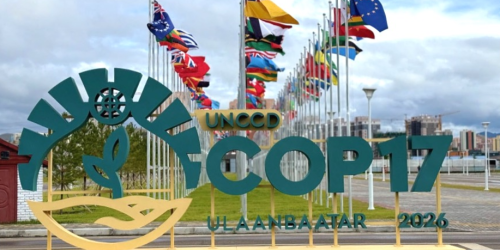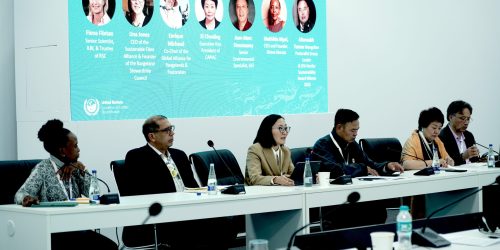
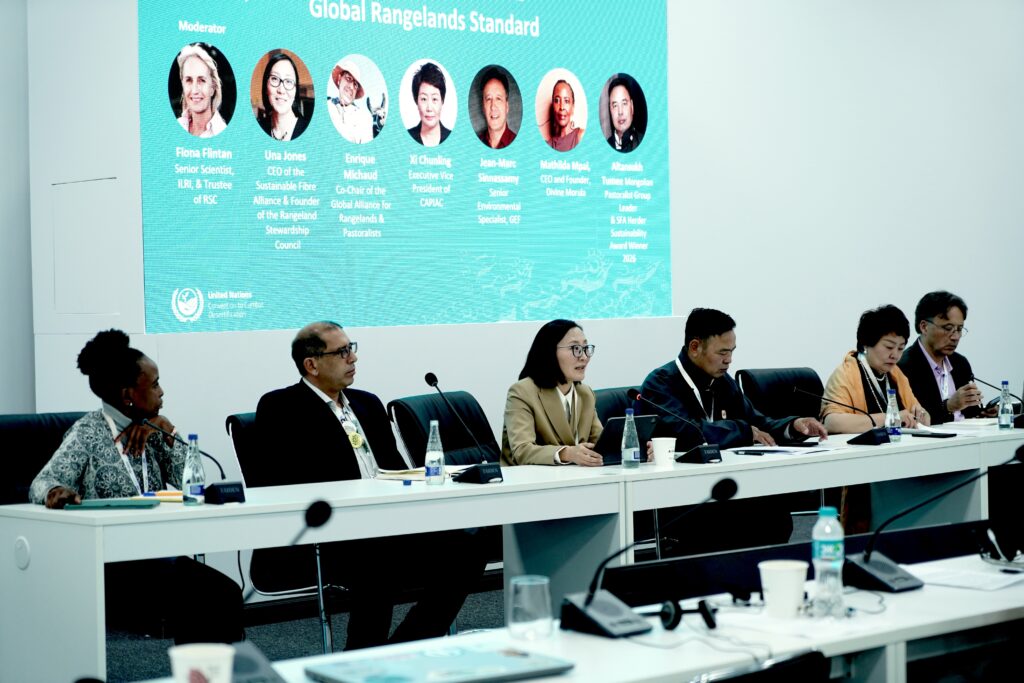
At UNCCD COP17 in Ulaanbaatar, the Rangeland Stewardship Council launched Version 0.2 of the Global Rangelands Standard — the Foundation Standard — marking an important step towards a shared global framework for responsible rangeland stewardship.
The launch on 26 August brought together pastoralists, governments, international organisations, technical experts and partners at a significant moment for the global rangelands community and the 2026 International Year of Rangelands and Pastoralists.
The discussion focused on a practical challenge: how can responsible stewardship be supported, demonstrated and recognised across the diversity of rangeland systems worldwide?
Rangelands support biodiversity, climate resilience, food and fibre systems, and the livelihoods, cultures and knowledge of communities around the world. Yet approaches to defining and recognising responsible stewardship remain fragmented.
The Foundation Standard provides a common global basis for addressing this gap, connecting stewardship on the ground with the policy, evidence, markets and investment needed to support and recognise it.
Built around the Realities of Rangelands
A standard for rangelands has to begin with a simple reality: rangelands are not uniform.
They encompass mobile pastoral and transhumant systems, ranching and settled livestock production. Land may be privately owned, communally managed, held through customary tenure or governed through combinations of formal and traditional systems. Access to pasture and water can shift with the seasons, and responsibility for managing resources may be shared across households, communities and landscapes.
The Global Rangelands Standard has been designed with this diversity at its core.
Its six Principles cover:
- Effective Management
- Responsible Land Governance and Tenure
- Land Management and Ecosystem Health
- Resilient Livelihoods
- Rights, Equity and Inclusion
- Animal Welfare
Together, they establish a common level of ambition for responsible stewardship while allowing application to respond to local ecological, cultural, legal and governance conditions.
As RSC Founder Una Jones said during the launch:
“The balance we are seeking is therefore a strong global foundation with locally designed application.”
That balance is critical. A global Standard needs enough consistency to create credibility and confidence, while also working in landscapes where governance, mobility, evidence and management may look very different from one place to another.
The aim is not uniformity, but a common foundation that can accommodate locally relevant indicators, knowledge and management approaches while maintaining clear principles, outcomes and safeguards.
A Standard Shaped through Dialogue
The launch at COP17 marked both the culmination of several years of consultation, technical review and refinement, and the beginning of the next phase of development.
Pastoralists and rangeland organisations, scientists and technical experts, industry, civil society, conservation organisations and international institutions have contributed to the process. Their input has helped shape the Standard around issues fundamental to rangeland stewardship, including communal and customary tenure, mobility, shared resources, pastoralists’ knowledge, biodiversity, climate resilience, adaptive management and animal welfare.
The Global Rangelands Standard is an RSC-led initiative, developed with support from UNCCD, the Sustainable Fibre Alliance and the GEF-funded STELARR Project, implemented by IUCN and executed by ILRI and partners.
This collaboration was reflected at COP17. The launch was moderated by Fiona Flintan, STELARR Project Lead and RSC Trustee, with contributions from Stewart Maginnis, Deputy Director General of IUCN; Jean-Marc Sinnassamy, Senior Environmental Specialist at GEF; and Louise Baker, Managing Director of the Global Mechanism at UNCCD. Government and pastoralist perspectives were also represented, including from Saudi Arabia, Botswana and the wider international rangelands community.
Together, these perspectives moved the conversation beyond what a global Standard should contain to the more important question of how it can work in practice.
What does good stewardship look like on the ground?
The question of how stewardship works in practice came into focus through the contribution of Altansukh Tumee, Mongolian Pastoralist Group Leader.
Speaking from the experience of Mongolian herders, he emphasised that responsible pasture management should be rooted in local knowledge and experience:
“When implementing the rangeland standard, it is appropriate to base it on the traditions of the local people and their experience in rangeland use.”
He described stewardship as practical and interconnected: herders, cooperatives and local associations identifying priorities together; planning pasture use and seasonal movements; protecting water sources and wildlife; preparing hay and feed; maintaining reserve grazing areas; improving livestock management; and addressing waste.
It is through examples such as these that the ambition of the Foundation Standard becomes tangible.
The Standard is designed so that management areas do not have to conform to fixed property boundaries. They may encompass seasonal and mobile grazing areas and land that is shared or overlapping. Participatory mapping, seasonal calendars and pastoralists’ knowledge can help reflect how landscapes are actually accessed, managed and governed.
The framework is intended to respond to the realities of rangelands, rather than requiring rangeland systems to reshape themselves to fit the Standard.
Carrying the Momentum of IYRP Beyond 2026
The launch also looked to the wider opportunity created by the International Year of Rangelands and Pastoralists.
Enrique Michaud, Co-Chair of the Global Alliance for Rangelands and Pastoralists, brought the perspective of the wider pastoralist movement, highlighting the importance of turning greater recognition of rangelands into continued cooperation and action.
Central to this is ensuring that pastoralist organisations remain directly involved as the Standard moves towards practical application.
IYRP and COP17 have helped place rangelands more firmly on the international agenda. The task now is to convert that visibility into lasting frameworks, partnerships and resources capable of supporting responsible stewardship over the longer term.
The Foundation Standard provides a pathway for carrying that momentum forward.
Connecting Stewardship with Support, Markets and Finance
Defining responsible stewardship is only part of the task. Creating the conditions that enable it is equally important.
Future application of the Standard will require complementary roles across governments, pastoralist and producer organisations, technical partners, civil society, financial institutions, businesses and market actors.
Governments can help align implementation with national priorities. Pastoralist and producer organisations must remain central to governance, design and learning. Technical partners can strengthen monitoring and evidence, while finance and market actors can support implementation, restoration and greater recognition of responsibly produced rangeland products.
For this reason, the Global Rangelands Standard is intended to support more than certification.
It can provide a common basis for benchmarking, monitoring and landscape programmes, while contributing to responsible sourcing, policy and investment frameworks.
Its longer-term value lies in strengthening the connection between good stewardship on the ground and the systems capable of recognising, valuing and supporting it.
Building from the Foundation Standard
The launch at COP17 provides a clear starting point for the next phase.
Further technical review and stakeholder engagement will continue alongside the development of country-level guidance, implementation tools, species-specific animal welfare annexes, and monitoring and assurance systems. Together, these will support future pilot testing across different rangeland systems, landscapes and value chains.
The pilots will help test how clear and practical the requirements are, how they work across different tenure and governance systems, what evidence is credible and feasible, and where further refinement is needed.
Ultimately, the ambition extends beyond the Standard itself. It is about what a shared global framework can help enable: healthier and more resilient rangelands, stronger livelihoods, greater recognition for responsible stewardship, and better-informed decisions grounded in both evidence and local knowledge.
The Foundation Standard gives the global rangelands community a common basis from which to move that ambition forward.
Explore the Global Rangelands Standard
Version 0.2 of the Global Rangelands Standard — the Foundation Standard — is now available through the Rangeland Stewardship Council website.
The High-Level Summary provides an accessible introduction to the Standard, its purpose, scope and six Principles, while the full Foundation Standard sets out its complete Principles, Themes, Requirements and supporting guidance.
RSC welcomes feedback and engagement from pastoralists and other rangeland users, governments, technical and scientific partners, civil society, businesses, finance and market actors, and potential pilot partners as the next phase of practical application and learning begins.