At the Natural Fibre Connect Conference 2025 (21–22 September, Edinburgh), conversations across science, policy, finance, and fashion converged around a shared reality: rangelands are foundational to natural fibres systems and demand urgent, collective action.
Across two dedicated sessions, the Rangeland Stewardship Council (RSC) brought rangelands from the margins to the centre of discussion—positioning them not as distant environmental concerns, but as living systems under pressure. Systems that sustain livelihoods, anchor supply chains, and play a critical role in climate resilience and the long-term viability of sustainable fashion.
Financing Rangelands: From Risk to Opportunity
The breakout session Financing the Future of Rangelands: Sustainable Investment Pathways for the Fibre and Fashion Sector addressed a central challenge for restoration: how to mobilise finance at scale and reposition rangelands from high-risk landscapes to investable systems.
Moderated by Una Jones (RSC Director; CEO of the SFA), the session brought together perspectives from the UN Convention to Combat Desertification (UNCCD), the International Livestock Research Institute (ILRI) and experts in standards and conservation science. Discussion focused on how financial mechanisms can move beyond risk avoidance to support regeneration and long-term land health.
The session opened by highlighting the global significance of rangelands, which cover more than half of the Earth’s land surface and support nearly two billion people, yet with up to half degraded. In this context, restoration stands out as one of the most cost-effective investment opportunities, with estimated returns of USD 7–30 for every dollar invested.
Speakers explored practical pathways for unlocking finance, including:
• Blended finance structures combining public, philanthropic, and private capital to reduce risk
• Robust monitoring, evaluation, and learning (MEL) systems to strengthen transparency and investor confidence
• Ecosystem service frameworks, such as the Rangeland Ecosystem Services Procedure (RESP), to measure and verify outcomes
• Impact credits that link ecological performance to financial value
Together, these approaches support an investment ecosystem that aligns financial returns with long-term land stewardship.
Collaboration for Rangelands: Fashion for Land
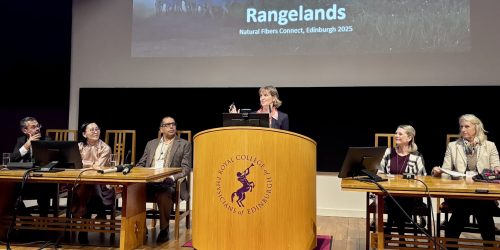
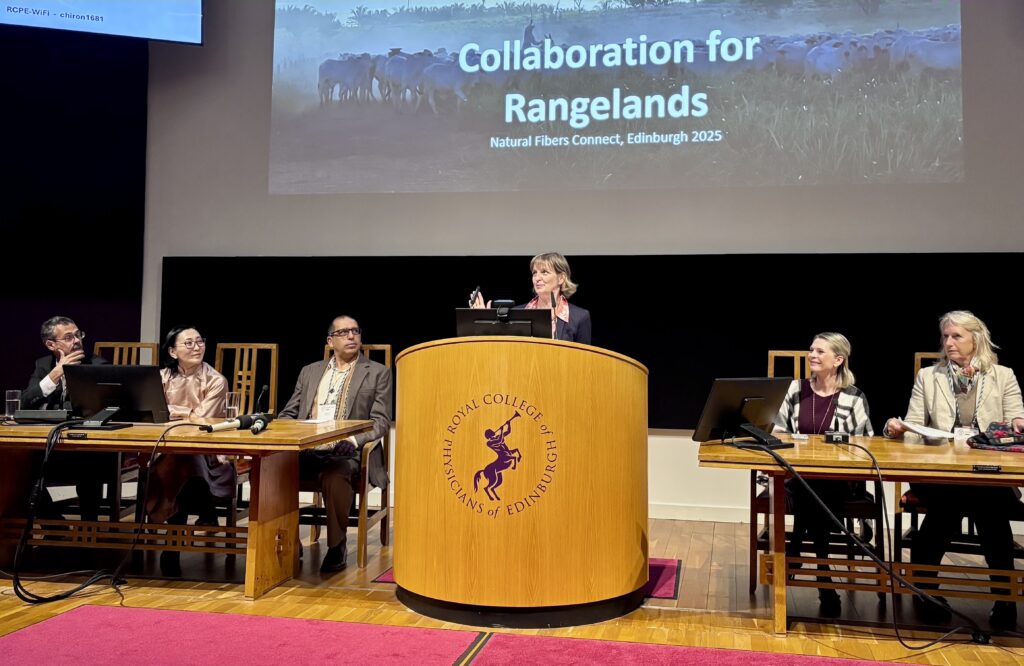
The plenary session Collaboration for Rangelands: Fashion for Land with the RSC broadened the conversation from finance to system-wide coordination, positioning collaboration as essential for meaningful scale.
Moderated by Anne Gillespie (RSC Strategic Lead), the discussion was framed against the road to the International Year of Rangelands and Pastoralists (IYRP) 2026 and the upcoming UNCCD COP17.
Opening the plenary, Xenya Scanlon, Chief of Communications, External Relations and Partnerships at UNCCD, grounded the discussion by centring land itself within fashion systems:
“I am here to talk about a stakeholder that was not mentioned, and yet is critical for the future sustainability, the survival of the businesses you lead in the fashion industry. And that stakeholder is, indeed, land.”
Panel contributions from UNCCD, the STELARR project, the Sustainable Fibre Alliance, and Better Cotton reinforced a shared conclusion: pastoralists cannot be expected to carry the burden of land degradation alone. Rangelands underpin fibre supply, climate stability, and biodiversity; safeguarding them is a collective responsibility.
Drawing on experience from Mongolia, Una Jones highlighted both opportunity and vulnerability. With livelihoods closely tied to livestock and cashmere, rangeland condition directly affects fibre quality, animal health, and community resilience. Rangeland stewardship, she noted, provides a pathway to restoring ecosystems while strengthening livelihoods.
Other speakers emphasised capacity, visibility, and collaboration as persistent challenges as well as powerful levers. As Damien Sanfilippo (RSC Steering Committee member; Founder, Better Cotton) observed:
“There is no lack of willingness to collaborate… what’s important is to do it better.”
Co-design, shared incentives, and aligned systems were repeatedly cited as prerequisites for progress.
From Conversation to Stewardship
Across both sessions, a consistent theme emerged: tools and solutions exist, but they must be connected through shared frameworks and partnerships. Standards, monitoring systems, finance mechanisms, and sourcing commitments are most effective when developed collaboratively and applied through shared approaches.
The RSC is working with partners to support this shift by developing a globally recognised benchmark for responsible rangeland management, linking verified outcomes to finance and sourcing decisions, and providing a collaborative platform for sustained engagement across sectors.
As attention turns toward COP17, the discussions in Edinburgh reinforced a shared understanding: rangelands are central to climate resilience, biodiversity, and sustainable fibre production—and their stewardship requires leadership, alignment, and collective responsibility.
For more information on how to engage with our work, contact us at info@rangelandstewardship.org.